
2019 Totals:
Number of Books: 33
Pages: 9,571
Audiobooks: 66 hours, 31 minutes
New Favorites: On Call in the Arctic, Darius the Great is Not Okay, I Am Still Alive, Becoming, Skyward, The Overstory
Old Favorites: The Egg and I, The Book of Mormon, Silas Marner, Big Magic
Favorite Vocab Words: stob: a broken branch or a stump
33. On Call in the Arctic: A Doctor's Pursuit of Life, Love, and Miracles in the Alaskan Frontier (2019.12.19)
By: Thomas J. Sims
Published: 2018
Pages: 307
Genre: memoir / Alaska / doctoring / medicine / America in the early 70s / the Arctic /
Bex Rating: 10
This book was such an unexpected treasure! Cori sent it to me for Christmas, along with a stock feeder and some new farm animals (Schleich). We almost always exchange our Christmas gifts in person, but, alas, it was not to be this year. However, we did carry on the tradition of not waiting until Christmas to open them! 😁
I thought I would just crack open the book and peek at a few pages . . . aaaaand I finished it in less than twenty-four hours. Cori knows me so well.

On Call in the Arctic is the true story of Doctor Tom Sims, who joined the Public Health Department as an officer so that he wouldn't be sent away from his young family to Vietnam. Fresh out of medical school, he took his toddler and pregnant wife
to his assigned station in Nome, Alaska, where he was the ONLY doctor, working with outdated (sometimes primitive) equipment, and a host of sicknesses, accidents, and conditions that are unique to Alaska.
It was funny, exciting, heart-wrenching, and so incredibly interesting. Dr. Sims used his recorded memories and journal entries to reconstruct this formative time in his life and the life of his young family. There's a lot of strong language, lots of graphic medical situations--and I loved the whole thing. I could not put it down, and it gets my rare level 10 score! Thank you, Cori!
- My life changed the moment I saw Juliette take the baby to her breast. I knew, without a doubt, I had found my calling in life. Despite all obstacles thrown in my path, being a doctor was the only career I could ever want. This child was not only a miracle in himself: he had created a miracle in me.
- The Cessna spun 180 degrees and buzzed toward me. When in got close enough, the reason for its odd appearance and labored flight became evident. Tied onto the planes skis, one half on each side, lay the gutted carcass of a full-grown moose.
- When faced with difficult decisions in the future, I would tally up my intellect and emotions and allow my heart equal influence with my head before deciding how to act. I learned that, more than likely, whichever way my heart was inclined was probably the way I should proceed.
32. Dear Mrs. Bird (2019.12.15)
By: AJ Pearce
Published: 2018
Pages: 309
Genre: historical fiction / WWII London / Women's magazines / journalism / friendship /
Bex Rating: 8.5
Emmaline, who has always dreamed of being a journalist, lands a job at a women's magazine. It's not as glamourous as being a war correspondent, but she plunges in and works hard for the magazine's domineering matron, Mrs. Henrietta Bird. Emmy is in charge of reading the "Dear Mrs. Bird" letters, and has explicit instructions to throw out any letters that are "unsavoury" or "inappropriate." Mrs Bird will not answer questions about anything controversial.
But Emmaline feels so sad for the women with real troubles who are writing in for advice. Against the counsel of her best friend, Bunty, Em starts
composing replies to women who are suffering through the repercussions of War. She slips them into the magazine and signs them "Mrs. Bird," knowing that it is wrong, but wanting to offer help.
It was a fun read, and a great story about friendship and honesty. There was a lot of great historical information about the London Fire Brigade--what a terrible and noble job! Made up of mostly volunteer citizens, who put their life on the line, night after night. And there was a sweet love story in there, too!
- But what about when things got difficult or went wrong? The paper didn't mention women like the ones who wrote to Mrs. Bird. Women, whose worlds had been turned upside down by the war, who missed their husbands, or got lonely and fell in love with the wrong man. Or who were just young and naive and had their heads turned in a trying time. Problems that people had always had, only now, with everything so topsy-turvy, they were expected to just battle on.
- Mother steadfastly referred to the War as This Silly Business, which made it sound like a mild fracas over a marmalade sponge.
By: Anne Tyler
Published: 2015
Pages: 371
Genre: contemporary fiction / family life /family epic / relationships / motherhood / home / houses / Man Booker Prize nominee
Bex Rating: 9.5

I don't think I have been this engrossed in a book all year. I could not stop thinking about the characters, long after I put the book down. Tyler's writing reads so effortlessly--the people and the feelings and the descriptions are so real and so artful.
This is the story of the Whitshank family--three generations who live in the Baltimore house built by Junior Whitshank. Maybe it's a story of the house? We jump back and forth in time, trying to understand Denny, the black sheep of the family, catching glimpses of his parents, Red and Abby, and their sweet courtship, and the complicated relationship pf Junior and Linnie May, who first left the backwoods of North Carolina and settled in the city. It highlights tender and funny and sweet moments, but also the very real jealousies and grievances that are part of family life.
To me, the over-arching message was that people mean well. People keep trying and keep going, despite hardships and setbacks and disappointments. There is love and security in families, even when people show it so imperfectly. (Also, it was squeaky-clean, which is a bonus).
- This was an attractive room, spacious and well designed, but it had the comfortable shabby air of a place whose inhabitants had long ago stopped seeing it.
- Abby passed her to Red, who made a big show of dismay and ineptness but later was caught pressing his nose to her downy head, drawing in a long deep breath of baby smell.
- And she did that modern thing of preparing a whole different dish for the children when they wouldn't eat their steaks.
- One thing that parents of problem children never said aloud: It was a relief when the children turned out okay, but then what were the parents supposed to do with the anger they'd felt all those years?
- "Who said, 'You're only ever as happy as your least happy child?'" she'd asked Ree in last weeks pottery class.
"Socrates," Ree answered promptly. - stob: a broken branch or a stump.
By: Brandon Sanderson
Published: 2018
Pages: 479
Genre: young adult science fiction / girl power / coming-of-age / friendship / mystery /
Bex Rating: 9
29. Big Magic: Creative Living Beyond Fear (2018.11.18, re-read)
By: Elizabeth Gilbert
Published: 2018
Audiobook Length: 5 hours, 6 minutes
Narrated by: Elizabeth Gilbert
Genre: self-help / conquering fear / creativity / motivational
Bex Rating: 9.5
28. Winter of the Witch, Book 3 of the Winternight Trilogy (2019.10.28)
By: Katherine Arden
Published: 2019
Pages: 376
Genre: historical fantasy / young adult / Russian folktales / Russian history / Winter
Bex Rating: 9
27. The Overstory
By: Richard Powers
Published: 2018
Pages: 512
Genre: modern fiction / trees / Pulitzer Prize / conservation / love story / epic /
Bex Rating: 9.75
26. Emily of New Moon
By: Lucy Maud Montgomery
Published: 1923
Pages: 265
Genre: young adult / humorous / coming-of-age / Canada /
Bex Rating: 9.5
25. The Essex Serpent
By: Sarah Perry
Published: 2016
Pages: 416
Genre: contemporary fiction / natural history / love story / feminism / domestic violence / healing
Bex Rating: 8
24. Becoming (2018.09.05)
By: Michelle Obama
Published: 2018
Audiobook Length: 19 hours, 3 minutes
Narrated by: Michelle Obama
Genre: autobiography / First Ladies / POTUS and FLOTUS / inspirational
Bex Rating: 9.5
23. The Book of Mormon: Another Testament of Jesus Christ (2019.08.05, 29th time)
Pages: 531
Genre: scripture / Jesus Christ / spiritual / self-help / nonfiction / Christian / answers to life's problems / history
Bex Rating: 10 (but of course)
22. Eleanor Oliphant is Completely Fine (2018.07.02)
By: Gail Honeyman
Published: 2018
Audiobook Length: 11 hours, 2 minutes
Narrated by: Cathleen McCarron
Genre: contemporary fiction / British / childhood trauma / social abilities / friendship / love story / humour
Bex Rating: 9
21. The Secret Garden (2018.05.22)
By: Frances Hodgson Burnett
Published: 1911
Pages: 341
Genre: children's classic fiction / British fiction / gardens / children / redemption / grief / friendship / healing power of nature
Bex Rating: 9
How have I never read this book? It was delightful. I knew the story pretty well, of course (and I LOVE the musical version), but it was great to read the original classic. And now I must read Burnett's other famous books for children: A Little Princess and Little Lord Fontleroy. Mary and Colin and Dickon are the main characters, of course. But Martha Sowerby was my favorite character by far.
- At that moment a very good thing was happening to her. Four good things had happened to her, in fact, since she came to Misselthwaite Manor. She had felt as if she had understood a robin and that he had understood her; she had run in the wind until her blood had grown warm; she had been healthily hungry for the first time in her life; and she had found out what it was to be sorry for someone. She was getting on.
- Mother said that to me once," she said. "She was at her wash-tub an' I was in a bad temper an' talkin' ill of folk, an' she turns round on me an' says: 'Tha' young vixon, tha'! There tha' stands sayin' tha' doesn't like this one an' tha' doesn't like that one. How does tha' like thysel'?' It made me laugh an' it brought me to my senses in a minute."
She went away in high spirits as soon as she had given Mary her breakfast. She was going to walk five miles across the moor to the cottage, and she was going to help her mother with the washing and do the week's baking and enjoy herself thoroughly. - "Nothin' will do her more good than a skippin' rope. It's the sensiblest toy a child can have."
- "A woman as brings up twelve children learns more than her A. B. C. Children's as good as 'rithmatic to set you findin' out things."
- "It's rare good for thee," he said, nodding his head wisely. "There's naught as nice as th' smell o' good clean earth, except th' smell o' fresh growin' things when th' rain falls on 'em. I get out on th' moor many a day when it's rainin' an' I lie under a bush an' listen to th' soft swish o' drops on th' heather an, I just sniff an, sniff. My nose end fair quivers like a rabbit's, mother says."
- "He's been spoiled till salt won't save him."
- "Th' more they laugh th' better for 'em!" said Mrs. Sowerby, still laughing herself. "Good, healthy child laughin's better than pills any day o' th' year. That pair'll plump up for sure."
By: Malala Yousafzai
Published: 2013
Pages: 327
Genre: nonfiction / memoir / Middle Eastern conflict / Pakistan / Taliban / terrorism / education / bravery / Fathers and Daughters / human rights
Bex Rating: 9.5
This is not the kind of book I ever read voluntarily. So I am SO GLAD it was chosen for book club, because I loved it. It was totally engrossing from the first page. It was the perfect way to end my five-week reading slump.
I am ashamed to I didn't know so many things about Pakistan, about the Taliban, about conflict in the Middle East in general that I learned from reading this book. I love Malala's love of and defense of Islam and of her home country and valley. She makes it very clear that terrorists do not follow the teachings of the Q'uran or the Prophet, Mohammed . . . something that has always been obvious to me, but, amazingly, is greatly misunderstood by many Westerners.
It is a moving and powerful story. Malala has a bright voice and is unafraid to speak truth. I want to be more like her.
- School wasn’t the only thing my aunts missed out on. In the morning when my father was given a bowl of cream with his tea, his sisters were given only tea. If there were eggs, they would only be for the boys. When a chicken was slaughtered for dinner, the girls would get the wings and the neck while the luscious breast meat was enjoyed by my father, his brother, and my grandfather. “From early on I could feel I was different from my sisters,” my father says.
- Trying to organize them was "like weighing frogs."
- My father consoled me by telling me about the mistakes great heroes made when they were children. He told me that Mahatma Ghandi said "Freedom is not worth having if it does not include the freedom to make mistakes."
- My father was angry. "Just as we say, 'Nim hakim khatrai jan--"Half a doctor is a danger to one's life,' so, 'Nim mullah khatrai iman'--'A mullah who is not fully learned is a danger to faith.'" he said.
- "But you just use him to learn the literal meaning of the words; don't follow his explanations or interpretation. Only learn what God says. His words are divine messages, which you are free and independent to interpret."
- "At night our fear is strong, Jani," he told me, "but in the morning, in the light, we find our courage again." And this is true for my family. We were scared, but our fear was not as strong as our courage.
- My father would say to me, "Any organization which works for peace, I will join. If you want to resolve a dispute or come out of conflict, the very first thing is to speak the truth. If you have a headache and tell the doctor you have a stomachache, how can the doctor help? You must speak the truth. The truth will abolish fear."
- My parents never once suggested I should withdraw from school, ever. Though we loved school, we hadn't realized how important education was until the Taliban tried to stop us. Going to school, reading and doing homework wasn't just a way of passing time, it was our future.
- [My father] made bargains with God: "Even if she is injured, just let her survive." Eventually, my mother interrupted him. "God is not a miser," she said. "He will give me back my daughter as she was."
- We human beings don't realize how great God is. He has given us an extraordinary brain and a sensitive loving heart. He has blessed us with two lips to talk and express our feelings, two eyes which see a world of colours and beauty, two feet which walk on the road of life, two hands to work for us, and two ears to hear the words of love. As I found with my ear, no one knows how much power they have in their each and every organ until they lose one.
- As usual my father doesn't help in the kitchen, "Aba, you talk of women's right, but my mother manages everything! You don't even clear the tea things."
By: Delia Owens
Published: 2018
Audiobook Length: 12 hours, 12 minutes
Narrated by: Cassandra Campbell
Genre: southern fiction / love story / marshland / natural history / biology / mystery / coming-of-age / poverty / North Carolina / the sixties
Bex Rating: 9
Warning: this book has a couple of pretty steamy scenes, and plenty of swearing. That said, I could not put it down, thought the writing was excellent, the story haunting and sweet, and the ending so satisfying.
This is the story of Kya Clark, abandoned by her mother at age five, she is left with her alcoholic father and siblings in a rundown shack, deep in the coastal marshland of North Carolina. One by one, her older siblings leave home to make their own way, and even Kya's father eventually disappears. She is left to fend for herself, growing up feral in the marsh, supporting herself by digging mussels and selling them.
Her only friend is Tate Walker, an older boy who teaches her to read, treats her kindly and with love, but then he, too, abandons her to the marsh.
The story switches back and forth between Kya's growing up years in the 50s and 60s to a mysterious murder in 1969. As Kya grows older, the reader begins to guess at her connection to the murder, but nothing is revealed until the very last chapter.
It was a great love story, a great mystery, and a totally engrossing story.
- Life had made her an expert at mashing feelings into a storable size.
- A clutch of women is the most tender, the most tough place on earth.
- Not waiting for the sounds of someone was a release. And a strength.
- Tutored by millions of minutes alone, Kya thought she knew lonely.
By: Eowyn Ivey
Published: 2012
Pages: 386
Genre: fiction / magical realism /modern-day fairy tale / childlessness / grief / joy / human love / winter / Alaska / homesteading / friendship / women / Russian folktales
Bex Rating: 9.5
Oh, what a beautiful book! I had no idea when I picked it up at the D.I. that it was a contender for the Pulitzer Prize in 2012. But the first paragraph of the synopsis on the back was all I needed: "Alaska, 1920: a brutal place to homestead, and especially tough for recent arrivals, Jack and Mabel. Childless, they are drifting apart--he struggling to maintain the farm; she crumbling from loneliness and despair. In a moment of levity during the season's first snowfall, they build a child out of snow. The next morning, the snow child is gone--but they glimpse a young girl running through the trees."

It was beautiful and bittersweet, and slightly reminiscent of the young adult book I read at the beginning of the year: Snow and Rose. Mollie actually pointed this out, when she saw the cover of The Snow Child. A sad tale, but with moments of such love and joy woven throughout it. I loved every word.
- It [Alaska] was beautiful, Mabel knew, but it was a beauty that ripped you open and scoured you clean so that you were left helpless and exposed, if you lived at all.
- He thought Mabel would cry, and he wanted to be anywhere else. It was wrong and cowardly, and he'd done it before--when Mabel lost the baby and shook with grief, when the relatives whispered harsh words, when the Bensons asked about the child in the woods. But it was like a need to take a breath. The urge was too strong, and without saying another word, Jack left the cabin.
- She sat down at the table, a loaf of bread baking in the oven, and was comforted by the act of writing. It gave her a rational purpose.
- "Poor woman, here for days on your own, caring for a banged-up man. Strong as they are, they're like children with pain. No birthing to toughen them up, I say."
- You did not have to understand miracles to believe in them, and in fact Mabel had come to expect the opposite. To believe, perhaps you had to cease looking for explanations and instead hold the little thing in your hands as long as you were able before it slipped like water between your fingers.
- She had watched other women with infants and eventually understood what she craved: the boundless permission--no, the absolute necessity--to hold and kiss and stroke this tiny person. Cradling a swaddled infant in their arms, mothers would distractedly touch their lips to their babies' foreheads. Passing their toddlers in a hall, mothers would tousle their hair or even sweep them up in their arms and kiss them hard along their chins and necks until the children squealed with glee. Where else in life, Mabel wondered, could a woman love so openly and with such abandon?
By: John J. Rowlands
Illustrated by: Henry B. Kane
Published: 1947
Pages: 270
Genre: woodcraft / bushcraft / survival / memoir / cabin living / how-to
Bex Rating: 8.5
This is a memoir, written by a man who lived in the North Woods of Canada for ten or fifteen years on Cache Lake in the 1920s and 30s. It was a fun read--pure escapism.
- Time is a strange standard of measure, for its value changes so much, depending on what you’re doing and where you are.”
- When you live by yourself for a long spell time begins to seem like a pail with a hole in the bottom. You can dip up water with it, but it leaks out before you can make use of it. Living alone, be it in the woods or a big city, where you can be as lonely as in any wilderness, is a bad business. Men were not meant to live alone.
- Some old woodsmen might snort at including chocolate in a ration list, but all the experienced explorers know its great value as a food.
- A good woodsman has patience. He learns early that rushing does not often get you where you are going any faster than taking it quietly.
- If you have common sense, which is the same thing as good judgement, you don’t often get into trouble, and every time you do get into trouble you learn something about common sense the hard way.
- Once I discovered the endless pleasure of raising flowers, I look forward to it every year.
- No need to be uncomfortable just because you are camping.
- I can hardly describe the contentment that comes to me in November. Maybe it is a feeling of security, which is what everyone is looking for. The way I look at it, security and happiness are the same thing. On a stormy night when the trees thrash in the high winds that claw at the eaves, I sit listening to the murmur of the fire in the bog stove, at peace with myself and the world. Give me food to keep me strong, wood to keep me warm, good friends to talk to me, fine books to read, and I have all I need.
- Buckwheat Griddlecakes:
- 2 rouned cups buckwheat flour
- 1 rounded cup white corn meal
- 1 cup boiling water
- 3/4 cup milk
- 1 tsp salt
- 1/2 TBSP yeast
- 1/4 cup milk, slightly warmed
- 1/2 tsp soda
- 1 tsp molasses
- Mal de raquette: snowshoe lameness
By: Edward Abbey
Published: 1968
Pages: 337
Genre: southern Utah desert / memoir / Park Service / Arches National Park / deserts / ecosystems / wilderness / conservation
Bex Rating: 9
This one has been on my list for a while. I can't say I agree with all
of Abbey's sentiments about National Parks or the management of public/private lands . . . but I certainly can't deny what a gifted writer he is. It was a great book, and the descriptions of the desert were both lyrical and stark. It got me super excited for my own desert excursions--one as a family to Kanab, and one with my girlfriends to the Bears' Ears Wilderness, both places he talks about in this book.
Abbey spent many years in the fifties as a park ranger in Arches National Park, and writes (without apology) of how his time in the desert shaped him. I really enjoyed the book, and am on the lookout for more in this genre. The American desert is such a unique, remarkable, dangerous, wild, beautiful, harsh, and needed landscape.
- A man on foot, on horseback or on a bicycle will see more, feel more, enjoy more in one mile than the motorized tourists can in a hundred miles.
- A man could be a lover and defender of the wilderness without ever in his lifetime leaving the boundaries of asphalt, powerlines, and right-angled surfaces. We need wilderness whether or not we ever set foot in it. We need a refuge even though we may never need to set foot in it. We need the possibility of escape as surely as we need hope; without it the life of the cities would drive all men into crime or drugs or psychoanalysis.
- Water, water, water....There is no shortage of water in the desert but exactly the right amount , a perfect ratio of water to rock, water to sand, insuring that wide free open, generous spacing among plants and animals, homes and towns and cities, which makes the arid West so different from any other part of the nation. There is no lack of water here unless you try to establish a city where no city should be.
- Wilderness. The word itself is music.
- ...it seems to me that the strangeness and wonder of existence are emphasized here, in the desert, by the comparative sparsity of the flora and fauna: life not crowded upon life as in other places but scattered abroad in spareness and simplicity, with a generous gift of space for each herb and bush and tree, each stem of grass, so that the living organism stands out bold and brave and vivid against the lifeless sand and barren rock. The extreme clarity of the desert light is equaled by the extreme individuation of desert life-forms. Love flowers best in openness and freedom.
- All one to me -- sandstorm or sunshine I am content, so long as I have something to eat, good health, the earth to take my stand on, and light behind the eyes to see by.
15. The Egg and I (re-read 2018.03.24)
By: Betty MacDonald
Published: 1941
Audiobook Length: 9 hours
Narrated by: Heather Henderson
Genre: memoir / humor / ranching / chickens / self-sufficiency / marriage / Washington / off-the-grid
Bex Rating: 10
Allen and I listened to this audiobook while driving to Kanab and back for Spring Break. It is just as hilarious and delightful as I remember, but with way more swearing than I remember. My ears were burning a little because my kids were all in the car--it's different hearing swear words than reading them.
I was so glad that Allen loved this book, because it is one of my favorites. The night before we returned home, he said, "It's so nice to have a good book to look forward to on a long drive.
14. Where'd You Go, Bernadette? (2018.03.20)
By: Maria Semple
Published: 2012
Pages: 352
Genre: contemporary fiction / humor / mystery (kind of) / agoraphobia / architecture / neighbors / friends / gossip / social climbers / mental illness /
Bex Rating: 9.5
I read this book in one big gulp. I have seen it in every bookstore for several years (and many copies at the D.I.), but I was wary that it might be too risque. Then someone told me how much they loved it, so I checked it out of the library (I had no idea they were making a movie version, which is due to come out this summer, but I'll definitely be seeing it). I loved it, and laughed out loud in many places.
This is the story of Bernadette, a brilliant architect whose rise to fame and acclaim abruptly ends when she leaves the design scene in Los Angeles and moves to Seattle with her husband and young daughter. Ten years later, no one knows where she is or who she is, and she has become horribly reclusive and agoraphobic.
When her daughter, Bee, announces that she wants to go on a family trip to Antarctica, Bernadette throws herself wholeheartedly into the excursion, enlisting the aid of an online "assistant" to do all the shopping and preparing for her. All the while, she is avoiding nosy neighbors and the judgment of other mothers at her daughter's school.
It was hilarious and sweet and poignant and totally entertaining.
- I’d also like a fishing vest, one replete with zippered pockets. Back when I actually enjoyed leaving the house, I sat on a plane next to an environmentalist who spent his life zigzagging the globe. He had on a fishing vest, which contained his passport, money, glasses, and film canisters – yes, film, it was that long ago. The genius part: everything’s in one place, it’s handy, it’s zipped in, plus you can whip it off and plop it down on the X-ray belt. I always said to myself: next time I travel, I’m going to get me one of those. My time has come. You’d better get two...
[later] Oh! The fishing vest’s arrived. Thank you! Already, I’ve tucked away my glasses, car keys, cell phone. I may never take this thing off. - Did you have any idea that getting to Antarctica requires crossing the Drake Passage? Do you know that the Drake Passage is the most turbulent body of water on the entire planet? Well, I do, because I just spent the last three hours on the Internet.
Excerpt from my report on Sir Ernest Shackleton:
The Drake Passage is the body of water between the southern tip of South America at Cape Horn, Chile, and the Antarctic continent. The five-hundred-mile passage is named after the sixteenth-century privateer Sir Francis Drake. There is no significant land at the latitudes of the Drake Passage. This creates the unimpeded circular flow of the Antarctic Circumpolar Current. As a result, the Drake Passage is the roughest and most feared water in the world. - The drivers here are horrible. And by horrible, I mean they don't realize I have someplace to be . . . Sometimes these cars have Idaho plates. And I think, What the hell is a car from Idaho doing here? Then I remember, That's right, we neighbor Idaho. I've moved to a state that neighbors Idaho. And any life that might still be left in me kind of goes poof.
- I quickly learned that in the name of closure, Dad would let me do anything.
- "I think my favorite part of Antarctica is just looking out."
You know why?" Dad asked. "When your eyes are softly focused on the horizon for sustained periods, your brain releases endorphins. It's the same as a runner's high/ These days, we all spend our lives staring at screens twelve inches in front of us. It's a nice change."
By: Susan Meissner
Published: 2014
Audiobook: 10 hours, 8 minutes
Read by: Tavia Gilbert
Genre: historical fiction / New York City / Triangle Shirtwaist Fire / 9-11 / losing loved ones / deceit and truth / coping with grief and loss / love story / trust / immigrants /
Bex Rating: 9.5
This is one of the best book club books we've had in a long time--I absolutely loved it! It was well-written, well-read by the audiobook performer, and had an intricate plot and sweet love story. I don't know why Susan Meissner doesn't sell marigold scarves on her website, because everyone who reads this book will want one!
The story jumps back and forth between 1911 and 2011 in New York City, weaving the tragedy of the Triangle Shirtwaist fire with the bombing of the World Trade Center. A scarf with a pattern of marigolds links Clara Wood, a nurse on Ellis Island who lost the man she loved in the Asch Building fire, and Taryn Michaels, a textiles designer whose husband died in the terrorist attacks of 9-11.
I feel slightly ashamed to admit that this book made the World Trade Center attacks more real to me than even when I lived through that time. I was a brand-new mother in 2001, and though 9-11 was tragic and troubling and horrible--it was so far from me, both geographically and personally. But A Fall of Marigolds really took me to that horrible day in Manhattan and helped me see it from a personal perspective. It brought back memories of that time in America (now an unbelievable 18 years ago), and really awakened a sense of empathy for all who personally lost loved ones that day. It is a somber day for every American . . . but especially for New Yorkers, and for individuals who survived the terror of that event.
Most of the story takes place in 1911. There are five chapters about Clara and Ellis Island for every one chapter involving Taryn (in 2011). I'm not really going to give a synopsis, but I wholeheartedly recommend this book to anyone and everyone--it is uplifting, wholesome, and inspiring.
PS- Tavia Gilbert is a pretty incredible narrator! I looked her up and she's won audie awards for her narrations--her accents were especially delightful. I loved listening to her bring this book to life--it gave me a hankering for more audiobooks.
- I understood nothing really about love, only that it was the most devastating, most spectacular, most desirable force on earth. Love was both the softest edge and the sharpest edge of what made life real.
- My choices that terrible morning had been prompted by love. What others had chosen had been prompted by hate. The effects of our choices had spilled onto each other. They always did.
By: Wade Brackenbury
Published: 1997
Pages: 252
Genre: memoir / China / Tibet / adventure / backpacking
Bex Rating: 8
I picked this book up at the D.I. and it was a quick, fun read. Writing is not the author's strong suit, but the story of trying to be the first foreigner to enter the Drung Valley on the border of China and Tibet was super compelling. Brackenbury kept detailed journals of his experiences in China in the 90s and so was able to reconstruct his journey very well. I especially loved the descriptions of the people and their hospitality, and of the rugged mountain landscape. It didn't hurt that the author is a fellow Idahoan and member of my church!
11. The Goldfinch (2018.03.01)
By: Donna Tartt
Published: 2013
Pages: 771
Genre: contemporary fiction / Pulitzer Prize winner / art theft / loss / self realization / artists / New York City / coming-of-age / drugs / depression / guilt / truth / beauty / art
Bex Rating: 9
Even though this is the third "9" I am giving in a row, I don't really recommend this book--there is so. much. foul and filthy language I cannot pass it along to anyone in good conscience.
But I did love it.
I read the first 200 pages years ago, when Cori gave it to me for my birthday, knowing that I loved Donna Tartt's previous two books. But it was so dark and depressing, I stopped reading it. Fast forward to 2019: I saw it in the high school library and immediately checked it out, because I have been wanting to know how it ends for years. Fortunately, I was not feeling as down as when I first attempted to read it, so I made it through this time.
Thirteen-year-old Theo Decker is in an art museum in New York City when a bomb goes off. He wakes up, dazed, to find that his mother has died in the explosion. Reeling from the accident, he encounters a dying man named Welty, who presses a ring on him and tells him where to take it. Theo takes the ring . . . aaaaaaaaaaand, he takes a world famous painting, The Goldfinch, by Carel Fabritius.
The story follows Theo through the years as he copes with his loss and grief, finding both solace and terror in the stolen painting. The Goldfinch comforts him, though the theft also haunts him. He moves to Las Vegas with his alcoholic, narcissistic father, and becomes best friends with a Russian boy named Boris. Boris and Theo experiment with every drug they can get their hands on, trying to drown out and forget the pain of the world.
When Theo's father is killed, Theo finds all the cash (and drugs) he can, and runs "home" to New York City, though he is only 15 years old. He lives with Hobie, the man he met when he returned Welty's ring, and becomes a furniture restorer. All the while, he hides the stolen painting, spiraling into a world of drug addiction to cope with his anxiety and depression.
The writing is so stark and beautiful and introspective: Tartt's hallmarks. It's a totally different life and different world than I have ever experienced, and I guess that's part of the draw: Tartt really does take her readers into worlds they may not (and probably would not) otherwise go. I really loved it. Buuuuuuuuuut, I don't think it belongs in a high school library 😉.
- I knew him well enough to know that if you asked him the right way, at the right moment, he would do almost anything; and in the very act of turning away I knew he would have run after me and hopped in the car laughing if I'd asked one last time.
- Time slid from under me in drifts like ice skids on the highway, punctuated by sudden sharp flashes where my wheels caught and I was flung into ordinary time.
- By contrast Hobie lived and wafted like some great sea mammal in his own mild atmosphere, the dark brown of tea stains and tobacco, where every clock in the house said something different and time didn’t actually correspond to the standard measure but instead meandered along at its own sedate tick-tock, obeying the pace of his antique-crowded backwater, far from the factory-built, epoxy-glued version of the world. Though he enjoyed going out to the movies, there was no television; he read old novels with marbled end papers; he didn’t own a cell phone; his computer, a prehistoric IBM, was the size of a suitcase and useless.
- Because--the line of beauty is the line of beauty. It doesn't matter if it's been through the Xerox machine a hundred times ... Still with greatness, there's a jolt at the end of the wire. It doesn't matter how often you grab hold of the line, or how many people have grabbed hold of it before you. It's the same line. Fallen from a higher life. It still carries some of the same shock.
- Though sometimes I worked down in the basement with Hobie for six or seven hours at a time, barely a word spoken, I never felt lonely in the beam of his attention.
- We belonged together; there was a dream rightness and magic to it, inarguable; the thought of her flooded every corner of my mind with light and poured brightness into miraculous lofts I hadn't even known were there, vistas that seemed not to exist at all except in relationship to her.
- The problem (as I'd learned, repeatedly) was that thirty-six hours in, with your body in full revolt, and the remainder of your un-opiated life stretching out bleakly ahead of you like a prison corridor, you needed some fairly compelling reason to keep moving forward into darkness, rather than falling straight back into the gorgeous feather mattress you'd so foolishly abandoned.
- It was one thing to see a painting in a museum but to see it in all those lights and moods and seasons was to see it a thousand different ways and to keep it shut in the dark--a thing made of light, that only lived in light--was wrong in more ways than I knew how to explain.
- "We have art in order not to die from the truth." -Nietzsche
- You see one painting, I see another, the art book puts it at another remove still, the lady buying the greeting card at the museum gift shop sees something else entire, and that’s not even to mention the people separated from us by time—four hundred years before us, four hundred years after we’re gone—it’ll never strike anybody the same way and the great majority of people it’ll never strike in any deep way at all but—a really great painting is fluid enough to work its way into the mind and heart through all kinds of different angles, in ways that are unique and very particular. Yours, yours. I was painted for you.
- ...the pursuit of true beauty is a trap, a fast track to bitterness and sorrow, that beauty has to be welded to something more meaningful.
- Nosferatu: is a 1922 German Expressionist horror film . . . an unauthorized adaptation of Bram Stoker's Dracula. Various names and other details were changed from the novel: for instance, "vampire" became "Nosferatu" and "Count Dracula" became "Count Orlok".
By: Wendelin Van Draanen
Published: 2017
Pages: 311
Genre: young adult fiction / drug rehab / healing / wilderness therapy / forgiveness /
Bex Rating: 9
Wendelin Van Draanen wrote one of my all-time favorite young adult books, Flipped (which is also an excellent movie), and so I will pick up every one of her books and give it a try. I loved this one! And, side-note, I read it in in-school suspension in a day (I had to sit with a young man and make sure he was working all day).
Wren Clemmens can't make herself believe that, at fourteen, she is being taken away by law enforcement in the middle of the night and put on a plane. Her parents, who don't know how to help their daughter in the face of her drug abuse, shoplifting, stealing, and destruction, have signed away custody and paid for her to attend a wilderness therapy course in the Utah desert.
Wren spends her first days and weeks in denial, and refuses to accept instruction or follow the rules, but decides to "play along" just so she can achieve certain privileges. The first turning point comes when she makes fire on her own, with a bow and drill.
Throughout her journey in rehab, flashbacks illuminate the choices Wren made that led her there. It was well-written and believable--you can't help but root for Wren!
- "Anger is a dry riverbed. You should follow it only if it leads to the spring of forgiveness."
- Moving from Rabbit to Coyote is a ritual. There are steps. Solemn stares. The burning of sage. The eating of candy.
- Taking the new jobs and getting out of San Francisco meant they could afford to buy a house instead of rent an apartment. We'd have space. Maybe get a dog. It was all rosy. A dream.
Except nobody was ever home. Mo went to after-school daycare, Anabella found an instant circle of friends, I found Meadow, and the dog was a rabbit that dies after three weeks.
When we lived in San Francisco, Tuesday was taco night and Thursday was spaghetti night. The other nights were wild cards, but I always looked forward to mom's cooking on those two nights. Everyone did.
After we moved, Domino's and Panda and Taco Bell became our dinner choices.
All the extra space did was give us room to drift apart. - "If we walk far but are angry as we journey, we travel nowhere. If we hold grudges as we scale mountains, our views remain the same."
- It's strange how you can hear people's voices in your head. Not just their words--their voices.
- I don't know why seeing a letter from my mom in her own handwriting means so much to me, but it does. Maybe because it comes from her hand, not a machine. Maybe it's because I feel like she touched the page, didn't just press print. Maybe because it means she listened.
By: David Arnold
Published: 2015
Pages: 356
Genre: contemporary fiction / coming-of-age / mental illness / runaways / losing loved ones / true friendship / healing / journey-as-allegory / humor / divorce / trauma
Bex Rating: 9
David Arnold is as sharp and witty and real as they come. His writing is so incisive--I immediately took to Mim and laughed and cried through her journey to get back to her mother.
Mary Iris Malone (Mim) has been taken from her mother by her dad and his new wife, from Ohio to Mississippi, which she refers to, derogatorily, as "Mosquitoland." When she suspects that her mother has cancer, she has no qualms about stealing her step-mom's stash of cash and catching a greyhound bus to see her mother. Each chapter begins with a letter that Mim writes to, presumably, her aunt, explaining and justifying her actions.
Along the way, Mim makes friends with several unlikely characters, who protect her and help her heal from both the demons of her past, and the real-world predators of her present.
I wasn't quite satisfied with the ending--it felt a little rushed, and too much was left unsaid. But I could not put this book down once I picked it up.
*This is a book for teens, but be warned it is chock full of super-strong language.
- I was in algebra II, watching Mr. Harrow carry on a romantic relationship with his polynomials.
- Dr. Wilson asked a few more questions and jotted down some notes while I studied his office. Cozy plants. Cozy chairs. A mahogany desk, no doubt the price of an Audi. And behind the good doctor, his Wall of Hubris: I counted seven framed degrees, hung with care and pride and more than a little jackassedness. Oh-ho, you don't believe I'm important, eh? Well then, how do you explain these?!?!?!
- I asked if Dad was right, if Reggie was just a lazy drunk. Mom said some homeless folk were like that, but she didn't think Reggie was one of them. She said even if he were, she would still give him the three bucks. She said it wasn't her job to pick which ones were genuinely starving and which ones were faking it.
- As luck would have it, across the street was this little plce called--I kid you not--Aces Dairy Dip Mart Stop Plus. I could not resist. (And really, why would I want to?)
- I don't know if you read comics, but if you do, you'll notice that there usually isn't much that separates the villain from the hero. Lonely outcats, masked identities, troubled childhoods, misunderstood by all--very often, there's a pivotal scene toward the end (usually during a massive thunderstorm) where the villain tries to convince the hero that they're the same.
- Closing my good eye, I will every ounce of stealth, speed, and moxie into the toes of my Goodwill shoes. Mom--the flame of my fuse, the wind in my sail, the tick-tick-ticking clock in my ear--is sick. Labor Day is two days away. Forty-eight hours. I breathe in, out, in out. I am energized. I am galvanized. I am mobilized, oxidized, and fully realized.
I am Mary Iris Malone, the Mistress of Moxie. - I'm not above eating fries while being indignant. If anything, indignation is bolstered by fries.
- "Your mother and I are getting divorced.
Seven words. All it took to wash away the millions that came before. I'd heard them in movies, on TV, read them in books. I'd heard them probably dozens of times in my life. Yet somehow, never . . . in my life, you know? - A flock of teenage girls stands in front of us in line, each one carrying identical shopping bags. The bags depict a group of ripped, shirtless dudes on a pier. Plastered across the top in bold marquee lettering it says LIVE YOUR LIFE.
It's an odd feeling, being chagrinned by your own generation. - When it's slow, it's called growth; when it's fast, it's change.
- Sunrise Mountain Rehab slaps me in the face with its unapologetic frontier motif. Standing between a butter churn and a rodeo saddle, I'm thinking it should apologize--to me, yes, but not exclusively. This place owes an apology to all who have had the misfortune of setting foot inside its hellish doors.
On a throw rug a bald eagle soars atop snow-covered mountains; it is majestic, patriotic, and above all, obnoxious.
Locating the nearest ladies' room, I run inside and slam the door behind me. But there's no escaping the resiliency of the eagles. They've soared their way in here as well, at least a hundred of them, flapping their wings for freedom, hovering, circling, diving, intent on breaking out of their embroidered wallpaper prison.
By: Adib Khorram
Published: 2018
Pages: 314
Genre: young adult fiction / depression / Iran / mental illness / friendship / father-son relationships / tea / grandparents / American Iranians
Bex Rating: 9.5
I finished this book during the seventh grade basketball game (waiting for Brig's 8th grade game to start) in the high school gym. With tears streaming down my face. It was so beautiful, uplifting, empowering, and hopeful. I think fiction is the perfect vehicle to teach people how to respond with compassion to depression and other mental illnesses. It spoke to me specifically, because I have many, close loved ones who struggle with depression.
And it doesn't hurt that the cover is exquisite.

In Iran, Darius makes a true friend, Sohrab, who treats him with a kindness and respect he has never known. Though most of his Iranian relatives frown upon medication and mental illness, Sohrab is inquisitive and kind about Darius' struggle. Darius also mends some of the relationship issues he has with his own father, Stephen Kellner, on this weeks-long trip.
In addition to the deft treatment of depression, which is the book's main focus, I also came away wanting to know more about Iran and Iranians--it was wonderfully descriptive and touching. It also deals with a lot of difficult and mature topics: I would recommend for mature 16-year-olds and up. I typed the ENTIRE afterword below, because it was so beautiful.
- The kind [of clothing store] that had pictures of shirtless guys with abdomens that could only be expressed in integers.
- I was overweight, period, which is why Stephen Kellner was always handing me the salad bowl.
As if salad would counteract the weight gain from my meds.
As if lack of discipline was the root of all my problems.
As if all the worry about my weight didn't make me feel worse than I already did. - No one ever threw their arm over my shoulder the way Sohrab did. Like it was perfectly fine to do that sort of thing to another guy. Like that was a thing friends did to each other.
- "Everyone wants you here. We have a saying in Farsi. It translates 'your place was empty.' We say it when we miss somebody."
- Stephen Kellner didn't like it when I got upset.
He didn't like it when I had feelings. - Sohrab was hurting and there was nothing I could do. Nothing except sit there and be his friend.
But maybe that was enough. Because Sohrab knew it was okay to cry in front of me. He knew I wouldn't tell him not to have feelings.
He felt safe with me. - haft-seen: is a traditional custom in the new year holiday of Iranian known as Nowruz. Actually it is a table setting with 7 different items which its essential items letters start with (Sin-Seen "س")
- taarof: Tarof or Taʿârof (Persian: تعارف) is a Persian word which refers to an Iranian form of civility emphasizing both deference and social rank.
AFTERWORD of Darius the Great is Not Okay
In telling Darius's story, I wanted to show how depression can affect a life without ruling it--both as someone who lives with it, and as someone who loves people living with it.
I was twelve years old when I was diagnosed with major depressive disorder, and I spent four years working with my psychiatrist finding a medication (or, as it runes out, a combination of medications and counseling) to manage my symptoms. I count myself very fortunate: because my family has a history of depression, my parents knew to get me treatment, and provide the support structure I needed. I was fortunate too that my depression never led me toward self-harm.
Depression take different shapes for different people. For me, it took the shape of comfort eating (a lot). It took the shape of avoiding school for a month because I couldn't drag myself out of bed and face the morning. It took the shape of not doing my homework because I couldn't see the point in anything.
Even now, it sometimes takes the shape of staying at home, playing mindless video games, when I don't feel up to engaging with the outside world.
Living with depression can mean getting stuck in cycles of misunderstood motives, of always imagining the worst in people, or thinking they are imagining the worst in you.
It can means pushing people away because you don't think you're worth their time.
It can mean taking medication to stay alive--even if it dulls parts of yourself you don't realize are there. (It's absolutely worth it.)
It can mean imagining that the people who love you will never love you enough.
But depression can be just as hard to witness as it can be to live with. It's frustrating to love someone and be unable to help them.
It's frustrating to repeat the same cycles of misunderstanding over and over again.
It's frustrating to constantly tell yourself that, if you could just figure out the secret, you could make everything better--but you can't.
No matter what, though, depression does not have to rule your life.
If someone you love is living with depression, there is hope for them.
It takes patience, and kindness, and forgiveness.
I'm still learning ow to take care of myself, and how to take care of those I love.
If you're learning, too, there are resources available.
-Adib Khorram
- National Alliance on Mental Illness: nami.org
- Anxiety and Depression Association of America: adaa.org
- Depression and Bipolar Support Alliance: dbsalliance.org
- LDS perspective: Depression and Anxiety
- LDS perspective: Living With Depression
- LDS perspective: Depression
By: Dr. Henry McCloud and Dr. John Townsend
Published: 1992
Pages: 302
Genre: self-help / psychology / human interaction / healing / family / relationships / behavior / therapy
Bex Rating: 9
I finally read it! Cori's been after me to read it for years, and I think she may have even bought it for us. It is definitely worth reading for anyone--at it's core, it's all about strengthening and deepening relationships.
It's easy enough to understand the concept of "having boundaries," and it's also easy to envision having boundaries in relationships, or how others should exhibit boundaries . . . but it's quite another thing to take that brave step and tell the people you love your honest thoughts, wishes, hopes, and feelings.
This is a book about how to be true to yourself as a child of God. It is biblically-based, and written by two Christian therapists who have been practicing marriage and family counseling for decades. I am reminded of some advice a therapist gave Allen years ago: "Bringing estranged family members back together is so much easier than untangling families who are "enmeshed," who do not respect each other's boundaries."
I am going to be very frank: I read this book, and Allen is reading this book, specifically because we have had and continue to have a difficult time dealing with a family member who is often controlling, and who does not respect our agency or our boundaries.
However, this book is not about condemning or blaming or judging others--it is about experiencing the personal power and freedom that comes with having boundaries and hoping/expecting family, friends, and coworkers to accept and respect those boundaries--whether they do or not. It is not about changing others, or controlling others, or "fixing" others. Like most books of this kind, it is about helping and empowering yourself. And along the way, learning how to love (and parent! and befriend! and serve!) more honestly, more willingly and joyfully.
The best part about this book is something I did not even realize when I picked it up: it is about patterning our lives after the Savior, and following His teachings as we try to be more loving and honest in our relationships.
The Bible is a living book about relationship. Relationship of God to people, people to God, and people to each other. (235)The Bible is quoted throughout every section and paragraph, and Cloud and Townsend have a deep understanding of Christ's teachings which helps readers really grasp how to stop feeling guilt, shame, and unhappiness as a result of a lack of personal, social, and familial boundaries.
I typed a TON of favorite passages. The underlined ones are the most important to me, and the bolded and underlined are the very essence of what I think this book is really all about. Thanks, Cori!
- The concept of boundaries comes from the very nature of God. God defines himself as a distinct, separate being, and he is responsible for himself . . . God limits what he will allow in his yard. He confronts sin and allows consequences for behavior. He guards his house and will not allow evil things to go there. He invites people in who will love him, and he lets his love flow outward to them at the same time.
- People with poor boundaries struggle with saying no to the control, pressure, demands, and sometimes the real needs of others. They feel that if they say no to someone, they will endanger their relationship with that person, so they passively comply but inwardly resent. Sometimes a person is pressuring you to do something; other times the pressure comes from your own sense of what you "should" do. If you cannot say no to this external or internal pressure, you have lost control of your property and are not enjoying the fruit of self-control.
(2 Corinthians 9:7) - To rescue people from the natural consequences of their behavior is to render them powerless. This happens a lot with parents and children. Parents often yell and nag, instead of allowing their children to reap the natural consequences of their behavior. Parenting with love and limits, with warmth and consequences, produces confident children who have a sense of control in their lives.
- Scripture is full of admonitions to separate ourselves from people who act in destructive ways (Matthew 18:15-17; 1 Corinthians 5:9-13). We are not being unloving. Separating ourselves protects love, because we are taking a stand against things that destroy love.
- God's desire is for you to know where your injuries and deficits are, whether self-induced or other-induced. Ask him to shed light on the significant relationships and forces that have contributed to your own boundary struggles. The past is your ally in repairing your present and ensuring a better future.
Search me, O God, and know my heart: try me, and know my thoughts:
And see if there be any wicked way in me, and lead me in the way everlasting.
(Psalms 139:23-24) - The scriptures advise parents to "train up a child in the way he should go, and when he is old he shall not depart from it" (Proverbs 22:6). Many parents misunderstand this passage. The think "the way he should go" means "the way we, the parents think he (or she) should go." Can you see the boundary conflicts already beginning?
The verse actually means "the way God has planned for him (or her) to go. In other words, good parenting isn't emotionally bludgeoning the child into some clone or ideal of the perfect child. It's being a partner in helping young ones discover what God intended for them to be and helping them reach that goal. - Power is not something you demand or deserve, it is something you express. The ultimate expression of power is love.
- A boundary is a property line. The whole concept of boundaries has to do with the fact that we exist in relationship. This law says that your boundaries need to be made visible to others and communicated to them in relationship. We have many boundary problems because of relational fears. We are beset by fears of guilt, not being liked, loss of love, loss of connection, loss of approval, receiving anger, being known, and so on. These are all failures in love, and God's plan is that we learn how to love.
- Healing always takes place in the light . . . This is the path to real love: communicate your boundaries openly. (Ephesians 5:13-14)
- Is it possible that other will become angry at our boundaries and attack or withdraw from us? Absolutely. God never gave us the power or the right to control how others respond to our no. Some will welcome it; some will hate it.
- Those who can't respect our boundaries are telling us that they don't love our no. They only love our yes, our compliance.
- Because he genuinely loved the warm family in which he was raised, Nathan felt guilty and disloyal when he remembered occasions in which his attempts to separate from his parents and set his own limits were constantly and lovingly frustrated.
- Individuals with mature boundaries are the least angry people in the world.
- She did not have emotional permission to be a separate person, make free choices about her life, and not feel guilty when she did not do what her parents wanted.
The real problem is on the inside. Remember, boundaries define someone's property. Susie, and others like her, do not really "own" themselves. People who own their lives do not feel guilty when they make choices about where they are going. They take other people into consideration, but when they make choices for the wishes of others, they are choosing out of love, not guilt; to advance a good, not to avoid being bad. - When you react to something that someone says or does, you may have a problem with boundaries. If someone is able to cause havoc by doing or saying something, she is in control of you at that point, and your boundaries are lost. When you respond, you remain in control, with options and choices.
- When you set boundaries, be lovingly responsible to the person in pain.
Do not confuse boundaries with a new way to control a spouse. It is the opposite. It is giving up control and beginning to love. You are giving up trying to control your spouse and allowing him (or her) to take responsibility for his own behavior. - Punishment looks back. It focuses on making payment for wrongs done in the past. Discipline, however, looks forward. (Hebrews 12:10)
- When others in our support system let us know how our lack of self-boundaries hurts them, we are motivated by love, not fear.
- When one member tells another, "Your uncontrolled behavior makes me want to stay away from you. I don't feel I can trust you when you act like that," the out-of-control person isn't being parented or policed. He is hearing truth in love from a peer. He is hearing how what he does helps or damages those he loves. This kind of confrontation builds an empathy-based morality, a love-based self control.
- God respects our no. God gives a choice and allows the people involved to make up their minds.
- People who get angry at others for setting boundaries have a character problem. Self-centered, they think the world exists for them and their comfort . . . Their wish is being frustrated, and they get angry because they have not learned to delay gratification or to respect others' freedom. (Proverbs 19:19)
- Guilt messages are not given for your growth and good. They are given to manipulate and to control . . . If guilt works on you, then this is your problem and not theirs. Realize where the real problem is: inside. Then you will be able to deal with the outside correctly, with love and limits . . . You do not owe guilt-senders an explanation.
- Many people are afraid to forgive because they equate that with letting down their boundaries one more time and giving the other person the power to hurt them again.
The Bible is clear about two principles: (1) We always need to forgive, but (2) we don't always achieve reconciliation . . . God forgave the whole world, but the whole world is not reconciled to him. Although he may have forgiven all people, all people have not owned their sin and appropriated his forgiveness. That would be reconciliation. Forgiveness takes one; reconciliation takes two.
By: George Eliot (Mary Anne Evans)
Published: 1861
Pages: 175
Genre: classic English literature / fiction / family / paternal love / allegory / moral tale / social critique / Victorian England
Bex Rating: 9.5
Oh, I love this story. I think it is so sweet, and so full of really astute observations about human nature and human vice. This is my second time reading it, and my second time watching the delightful BBC movie version from the 80s with Ben Kingsley as Silas. The movie so closely follows the book--it leaves almost nothing out and most of the dialogue is directly quoted from the book.
Silas Marner is a story about a man who is wronged in his youth and becomes lonely and bitter. He moves away and lives a miserly existence, his only joy is literally counting his money at the end of every day. When he is robbed of his hoard of gold, life ceases to hold meaning for him . . . until shortly after, a dying woman falls in the snow at his stone cottage, and her small child wanders inside. Silas finds new life and new purpose as he cares for the child, and the faith and trust of his youth return to him.
I think this short novel gives such a wonderful glimpse into country life during the Victorian era. I read a few essays about Mary Ann Evans after finishing this for the second time, and it is no wonder that her novel Middlemarch (which I have yet to read) is often described as the greatest English novel of all time. She was incredibly intelligent and had a gift for describing human nature and understanding difficult familial situations: two subjects that should be read about and talked about and learned about for everyone.
- All cleverness, whether in the rapid use of that difficult instrument the tongue, or in some other art unfamiliar to villagers, was in itself suspicious:
- A weaver who finds hard words in his hymn-book knows nothing of abstractions; as the little child knows nothing of parental love, but only knows one face and one lap towards which it stretches its arms for refuge and nurture.
- ...women seemed to be laying up a stock of linen for the life to come.
- No! he would rather trust to casualties than to his own resolve—rather go on sitting at the feast, and sipping the wine he loved, though with the sword hanging over him and terror in his heart, than rush away into the cold darkness where there was no pleasure left.
- A dull mind, once arriving at an inference that flatters a desire, is rarely able to retain the impression that the notion from which the inference started was purely problematic. And Dunstan's mind was as dull as the mind of a possible felon usually is.
- Our consciousness rarely registers the beginning of a growth within us any more than without us: there have been many circulations of the sap before we detect the smallest sign of the bud.
- ...he was not to be moved from [his statements] after his anger had subsided—as fiery volcanic matters cool and harden into rock.
- ...he went to sleep thinking that he had done with inward debating. But when he awoke in the still morning darkness he found it impossible to reawaken his evening thoughts; it was as if they had been tired out and were not to be roused to further work.
- Godfrey was silent. He was not likely to be very penetrating in his judgments, but he had always had a sense that his father's indulgence had not been kindness, and had had a vague longing for some discipline that would have checked his own errant weakness and helped his better will.
- I suppose one reason why we are seldom able to comfort our neighbours with our words is that our goodwill gets adulterated, in spite of ourselves, before it can pass our lips. We can send black puddings and pettitoes without giving them a flavour of our own egoism; but language is a stream that is almost sure to smack of a mingled soil. There was a fair proportion of kindness in Raveloe; but it was often of a beery and bungling sort, and took the shape least allied to the complimentary and hypocritical.
- ...perhaps there was hardly a person in the parish who would not have held that to go to church every Sunday in the calendar would have shown a greedy desire to stand well with Heaven, and get an undue advantage over their neighbours.
- ...she took her husband's jokes and joviality as patiently as everything else, considering that "men would be so", and viewing the stronger sex in the light of animals, whom it had pleased Heaven to make naturally troublesome, like bulls and turkey-cocks.
- Bob Cass was figuring in a hornpipe, and his father, very proud of this lithe son, whom he repeatedly declared to be just like himself in his young days in a tone that implied this to be the very highest stamp of juvenile merit...
- ...no disposition is a security from evil wishes to a man whose happiness hangs on duplicity.
- Marner took her on his lap, trembling with an emotion mysterious to himself, at something unknown dawning on his life. Thought and feeling were so confused within him, that if he had tried to give them utterance, he could only have said that the child was come instead of the gold—that the gold had turned into the child.
- The gold had kept his thoughts in an ever-repeated circle, leading to nothing beyond itself; but Eppie was an object compacted of changes and hopes that forced his thoughts onward, and carried them far away from their old eager pacing towards the same blank limit—carried them away to the new things that would come . . .
- The gold had asked that he should sit weaving longer and longer, deafened and blinded more and more to all things except the monotony of his loom and the repetition of his web; but Eppie called him away from his weaving, and made him think all its pauses a holiday, reawakening his senses with her fresh life, even to the old winter-flies that came crawling forth in the early spring sunshine, and warming him into joy because she had joy.
- In old days there were angels who came and took men by the hand and led them away from the city of destruction. We see no white-winged angels now. But yet men are led away from threatening destruction: a hand is put into theirs, which leads them forth gently towards a calm and bright land, so that they look no more backward; and the hand may be a little child's.
- "There's trouble i' this world, and there's things as we can niver make out the rights on. And all as we've got to do is to trusten, Master Marner—to do the right thing as fur as we know, and to trusten. For if us as knows so little can see a bit o' good and rights, we may be sure as there's a good and a rights bigger nor what we can know—I feel it i' my own inside as it must be so. And if you could but ha' gone on trustening, Master Marner, you wouldn't ha' run away from your fellow-creaturs and been so lone."
- Oh, I know," said Priscilla, smiling sarcastically, "I know the way o' wives; they set one on to abuse their husbands, and then they turn round on one and praise 'em as if they wanted to sell 'em."
- Godfrey felt an irritation inevitable to almost all of us when we encounter an unexpected obstacle. He had been full of his own penitence and resolution to retrieve his error as far as the time was left to him; he was possessed with all-important feelings, that were to lead to a predetermined course of action which he had fixed on as the right, and he was not prepared to enter with lively appreciation into other people's feelings counteracting his virtuous resolves. The agitation with which he spoke again was not quite unmixed with anger.
- That quiet mutual gaze of a trusting husband and wife is like the first moment of rest or refuge from a great weariness or a great danger—not to be interfered with by speech or action which would distract the sensations from the fresh enjoyment of repose.
- whitsuntide: the weekend or week including Whitsunday. Whitsunday is the name used especially in Britain and Ireland, and throughout the world among Anglicans and Methodists, for the Christian festival of Pentecost, the seventh Sunday after Easter, which commemorates the descent of the Holy Spirit upon Christ's disciples (Acts 2).
- nolo episcopari: It means, literally, "I do not wish to be bishoped." The traditional formal refusal made by a cleric in the Roman Catholic and Anglican churches of an offer as appointment as a bishop.
By: Kate Alice Marshall
Published: 2018
Pages: 314
Genre: young adult fiction / survival / revenge / coming-of-age / grief / solitude / dogs
Bex Rating: 10!
The first 10 of the year! And when I saw the cover to this book, I showed my husband and he said what I was thinking, "Someone wrote this book just for you." I loved every second of it. I love my library for having it out on display at just the right moment.

Jess Cooper lost her mother and the full use of the right side of her body in a terrible car accident. She is placed in foster care until authorities find her father in Alaska. But when Jess flies to Alaska to live with him, she finds out that his address is a fake: he really lives off the grid in Canada.
After days of fighting, Jess's dad agrees to move back to civilization if she gives it one year. But Jess doesn't have a year. Only weeks after she arrives, and before she acquires any skills that could help her, her father is shot and his cabin burned to the ground, while Jess watches from the forest where her dad had made her hide.
She is alone in the wild, with only her dad's dog, Bo, for company. And guess what keeps her fighting? Thoughts of (dun dun DUN) REVENGE.
Oh man, I loved it from beginning to end. It's definitely more a survival story than it is a revenge story. I need all the books of 2019 to be like this one.
- It was hard to look at the old photo, and I'd thought about keeping one with just Mom in it, but it wasn't just Mom I wanted. It was the two of us. It was her arm around me, and the wind that carried us both up, up, to where there was no one else. I looked at it every night. It was like if I didn't check it every night, it might disappear, and my memory of Mom with it.
- "You'll argue with a wall that it's a door, and walk through it just to prove it."
- I am hollowed out. I have spent every ounce of sorrow and despair, every last drop of emotion that I have. I don't think. I don't feel. I just move. I feel like I could run a matathon, but I know it's an illusion. Adrenaline, relief. Overconfidence. One of my many enemies out here, one of the small voices I have to ignore.
- Forgotten is the most alone you can get.
By: Faith Erin Hicks
Published: 2019
Pages: 269
Genre: young adult / graphic novel
Bex Rating: 9
I read the first two books in this graphic novel series last year in January. And got this one for myself with the money from returning a Christmas gift to Amazon. It cost me five cents: bonus!
Rat and Kaidu are the only ones who dare to sneak in the palace and steal the book that holds the secret to Napathu: a powerful fire that can be used both to build and destroy. The story is great, the characters are so fun (especially the warrior, Murda), and the art is beautiful and sweeping. A great series for anyone in your life who loves graphic novels!
3. A Winter's Promise: The Mirror Visitor Quartet, Book 1 (2018.01.15)
By: Christelle Dabos
Translated from French by: Hildegarde Serle
Published: 2013
Pages: 490
Genre: young adult fiction / fantasy / political intrigue / tyranny / love / betrothals / finding oneself / steampunk
Bex Rating: 9
Now this was some truly original fantasy! I don't even know how to describe it.
Ophelia is a gifted "reader": she can touch any object and read its history--who owned it and what they felt; she is so good that she can trace most objects back in time to their origins. She can also travel through mirrors, which is no small feat. Despite these gifts, Ophelia is a clumsy misfit who doesn't care about her appearance or about social norms. So it is a complete shock to her when her family receives a request for her betrothal to Thorn, the powerful treasurer of a distant "ark" near the North Pole.
Ophelia is wrenched from her home ark of "Anima" and thrust into a world where she can trust no one, least of all her fiance, Thorn. She becomes a pawn in a political game, in a world so unfamiliar and unfriendly.
The writing was great, the characters were even greater. As far as I can tell, three of the four books have been published in France, but only the first book has been translated into English. I can't wait to read the rest!
- She made herself breathe deeply, and accept the unavoidable. This time, it really was over. Tomorrow she wouldn't open her museum, as she did every morning. Tomorrow she would depend forever on a man whose name she would end up sharing.
- In other circumstances, Ophelia wouldn't have insisted. She valued her tranquility too much to debate, argue , stick up for herself, but this evening, it was the rest of her life that was at stake.
- Forgetting the dead was like killing them a second time.
- tromp l'oleil: visual illusion in art, especially as used to trick the eye into perceiving a painted detail as a three-dimensional object.
- nacreous: having a play of lustrous rainbow colors; "a milky opalescent luster" opalescent, opaline, pearlescent, iridescent, resembling mother-of-pearl.
By: Emily Winfield Martin
Published: 2017
Pages: 205
Genre: young adult / fairy tale / good vs evil / coming-of-age / bedtime stories / illustrations / woods
Bex Rating: 9.5
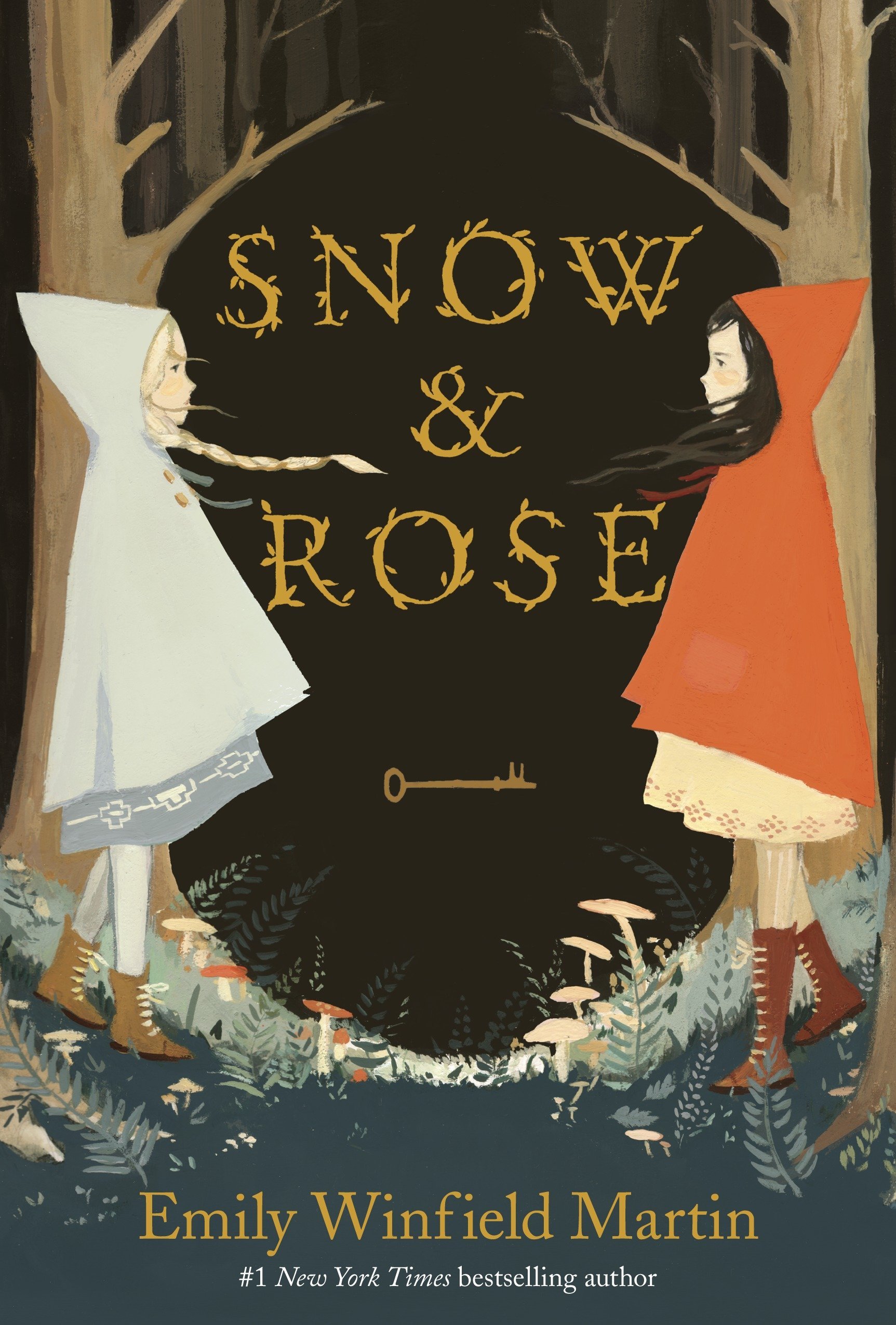
Mollie checked this book out of the public library, and I was itching for her to finish so I could read it, too. I loved it. And the color illustrations push this book from great to unforgettable. It's a perfect bedtime read-aloud for kids 8-12.
Snow and Rose are two sisters who have to move to a cottage in the woods after their father disappears. Their mother spends the first half of the book in a depressed funk, so the girls roam the woods unchecked, meeting people, animals, and creatures who mean them harm. The mother rouses from her stupor and begins to teach them how to cook, harvest, sew, and survive in their new harsh environment, but the girls keep returning to the woods in search of their father.
Some of Martin's descriptions blew me away with their beautiful concision (see excerpts below), not to mention her delightful, ethereal watercolor illustrations. It was pretty reminiscent of the Wildwood trilogy, (which I also highly recommend).
- Rose knew her sister was the kind of person who wanted to see or hear or taste something she loved over and over again, to remind herself that it was real. Rose was another kind of person: she wanted to hold on to a thing she loved as tightly as she could. She wanted to keep it special and safe, for fear that it might get used up--or worse, that it might escape, like sand or sugar slipping through her fingers.
- The items were labeled in the same curling writing they'd seen on the sign out front, only instead of white paint, these were written in ink and smudged pencil. A bit of coral, a spotted feather, a scrap of velvet, a paper crane, a delicate bone, a pebble of fool's gold, a ball of twine, a wooden spool, a slip of soap, a scrap of brown paper, a lock of hair, a scallop shell, a crooked spoon, a postage stamp, an acorn, a baby tooth, a silver button. [Isn't this list fabulous?]
- [Snow] wondered how people got to be the way they were. Why things angered her so, why they ran away with her, when they didn't bother Rose.
- Just before autumn faded, it burned bright with gusts of electric air, with the smell of wood smoke, everything dressed in gold and scarlet and bitter browns.
By: Stella Gibbons
Published: 1932
Pages: 233
Genre: classic fiction / humour / British country / parody
Bex Rating: 9
I picked up a copy of this book at Deseret Industries, remembering that my friend, Elisa Snow, loved the movie version from the 90's. This book is hilarious. It's so prideful and narrow-minded to think that a humorous novel is a "modern" invention. Because Stella Gibbons was killing it in 1932. She wrote this novel to gently poke fun at the types of countryside romance novels that were all the rage. I especially love her "letter" to the publisher (part of the fiction) in which she explains how she means to attempt fiction after being a journalist.
...the magnitude of the task which confronted me when I found, after spending ten years as a journalist, learning to say exactly what I meant in short sentences, that I must learn, if I was to achieve literature and favourable reviews, to write as though I were not quite sure about what I meant but was jolly well going to say something all the same in sentences as long as possible.I was giggling from beginning to end.
This is the story of Flora Poste, who goes to Cold Comfort Farm to "live off" her relatives, the Starkadders, after her parents die. She cannot help but take an interest in everyone at this gloomy, forsaken hollow, and immediately goes about trying to improve everyone's lives--whether they want her help or not.
I'm going to have to check out the movie version now . . .
- The education bestowed on Flora Poste by her parents had been expensive, athletic and prolonged; and when they died within a few weeks of one another during the annual epidemic of the influenza or Spanish Plague which occurred in her twentieth year, she was discovered to possess every art and grace save that of earning her own living. [What a great beginning!]
- She liked Victorian novels. They were the only kind of novel you could read while eating an apple.
- Surely she had endured enough for one evening without having to listen to intelligent conversation?
- Here was an occasion, she thought, for indulging in that deliberate rudeness which only persons with habitually good manners have the right to commit...
- After another minute Reuben brought forth the following sentence: "I ha' scranleted two hundred furrows come five o'clock down i' the bute."
It was a difficult remark, Flora felt, to which to reply. - Ye know, doan't ye, what it feels like when ye burn yer hand in takin' a cake out of the oven or wi'a match when ye're lightin' one of they godless cigarettes? Ay. It stings wi' a fearful pain, doan't it? And ye run away to clap a bit o' butter on it to take the pain away. Ah, but' (an impressive pause) 'there'll be no butter in hell!'
- Like all really strong-minded women, on whom everybody flops, she adored being bossed about. It was so restful.
2018 Book Reviews 52 Books: 15,788 pages + audiobooks
2017 Book Reviews 46 Books: 16,573 pages + audiobooks
2017 Book Reviews 46 Books: 16,573 pages + audiobooks
2016 Book Reviews 38 Books: 11,097 pages + audiobooks
2015 Book Reviews 51 books: 14,629 pages + audiobooks
2014 Book Reviews 53 books: 14,497 pages + audiobooks
2013 Book Reviews 54 books: 17,177 pages + audiobooks
2012 Book Reviews 57 books: 16,555 pages + audiobooks
2011 Book Reviews 47 books: 16,826 pages + audiobooks
2010 Book Reviews 45 books: 12,353 pages + audiobooks
2009 Book Reviews 43 books: before I thought of counting
2008 Book Reviews 58 books: before I thought of counting
2007 Book Reviews Aug-Dec: the year that I began to blog
2008 Book Reviews 58 books: before I thought of counting
2007 Book Reviews Aug-Dec: the year that I began to blog

No comments:
Post a Comment